Good care has always depended on good communication.
Knowing a resident’s preferences, tracking their health and wellbeing, responding quickly when they need support, keeping families informed: these are not new priorities. What is changing is the range of tools available to help us do all this well, with more time left over for the moments that matter most.
Across Red Homes Healthcare Group, we have been investing in technology that supports our teams, improves outcomes for residents and keeps families better connected to life in the home.
Nourish: care planning at the centre
Nourish is our digital care management platform, and it sits at the heart of how we record, plan and deliver care across all three homes. Every resident has a care plan within Nourish, updated in real time by the team members who know them best. Rather than relying on paper records, care information is always current and always to hand.
In practice, a carer beginning their shift can see straight away how a resident has slept, whether they have eaten well, and what kind of day they have had so far. For families, Nourish offers something particularly valuable: the ability to see key parts of a loved one’s care online, from wherever they are. That visibility can make a real difference, especially for families who live further away.
One family member, whose mother moved into one of our homes earlier this year, told us that seeing how her mum had slept, what she had eaten and whether she had joined in with activities was what she valued most. The photographs are a particular joy, and she passes them on to her own daughters so they can see how their Nana is getting on. If her mum has had an ‘off day’, she can ring and talk it through with the team. In her words, it has been a lifeline in helping her feel settled about the move.

Camascope: safer medication management
Managing medication in a care home is a significant responsibility. Camascope is our electronic medication administration record system, replacing the paper-based processes long standard across the sector.
Every administration is recorded digitally at the point of care. Each resident’s medication is linked to a unique barcode, which is scanned before anything is given. It is a simple step, but it provides real assurance that the right medication reaches the right person at the right time. The system also alerts staff to new prescriptions and to changes in a resident’s medicines, and where a dose has not been given, it flags this and prompts the team to act.
Our nursing team tells us the difference has been considerable. Instructions are clear, and timed reminders help enormously for residents whose medicines must be taken at precise times. Because Camascope links with Nourish, families can also see when medication has been given and by whom.
Intercall: responding when it matters
Our nurse call system, provided by Intercall, makes sure that when a resident needs assistance, the right member of staff is alerted promptly. For residents, that means help arrives sooner and worries are eased more quickly. Every call is also logged, which allows us to review response times and understand individual needs over time. Where a resident tends to need support at a particular point in the day, recognising that pattern helps us plan care around them.
Tiny Tablets: connection, creativity and engagement
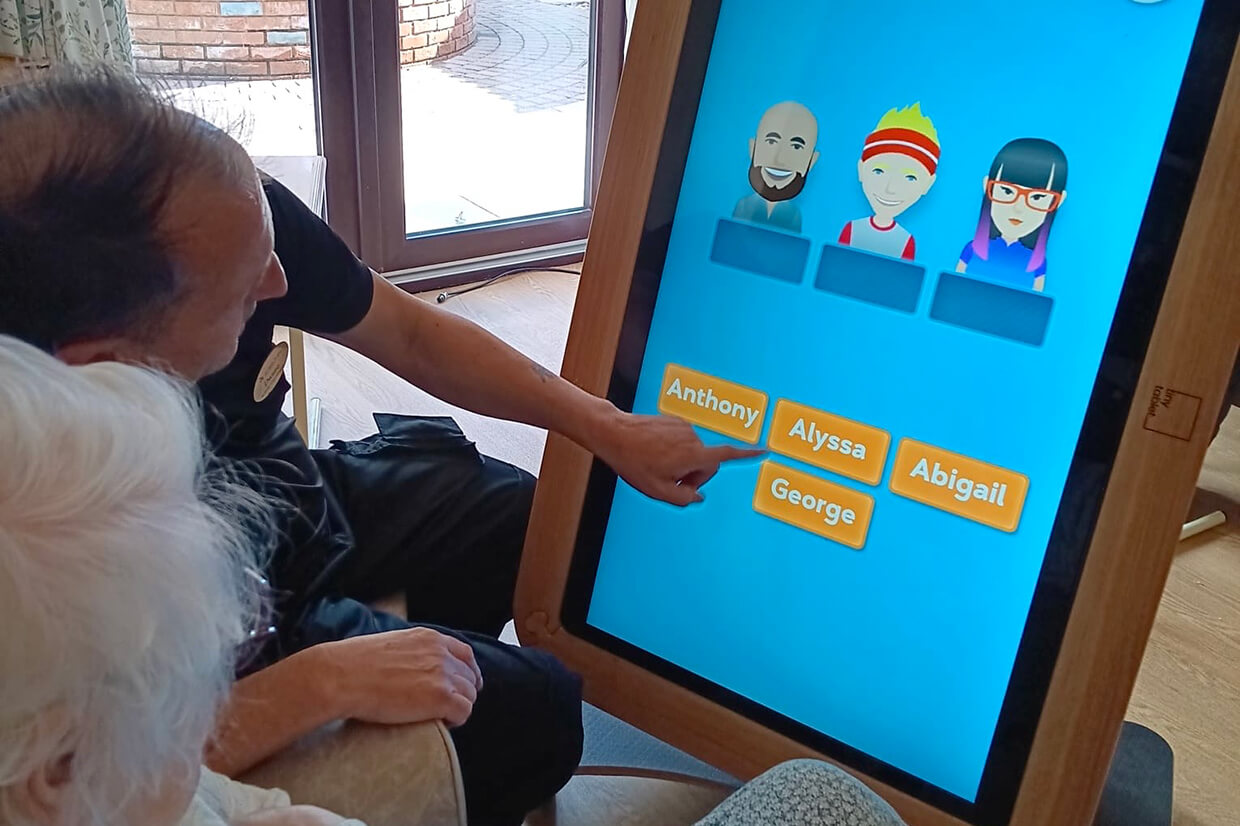
Alongside the systems supporting clinical and operational care, we have invested in technology that enriches daily life. Our Tiny Tablets are large, interactive touchscreen tables designed for care settings, and they have opened a new range of activities and opportunities for connection across our homes.
Our activities coordinators use them several times a week, and they work just as well for a quiet one-to-one session as for a larger group. Residents particularly enjoy the games and interactive content, from quizzes and dominoes to card games and sing-along sessions. Alongside the fun, there are sensory and reminiscence activities, which have proved especially valuable for residents living with dementia, helping them feel calm and relaxed while gently encouraging happy memories and conversation.
One quiet advantage is that care staff can use the Tiny Tablets too, not only the activities team, so residents can enjoy something engaging at any point in the day. For some, particularly those who find other forms of communication more difficult, they have offered a new way to engage with the world around them, and it is rewarding to see the difference they make.
Looking ahead: towards a paperless future
We are working towards becoming a fully paperless care home group, and we are honest that this is a journey rather than a destination we have reached. Change of this kind takes time. It requires investment in training, in confidence-building, and in bringing every member of the team along at a pace that works for them.
That process is ongoing, and we are committed to it. We believe the homes where residents receive the best care are those where the team has more time and attention to give, and where nothing important is lost in a paper trail. Every step towards a more connected and accurate way of working is a step towards better care.
We are proud of what we have built so far, and we are looking forward to what comes next.